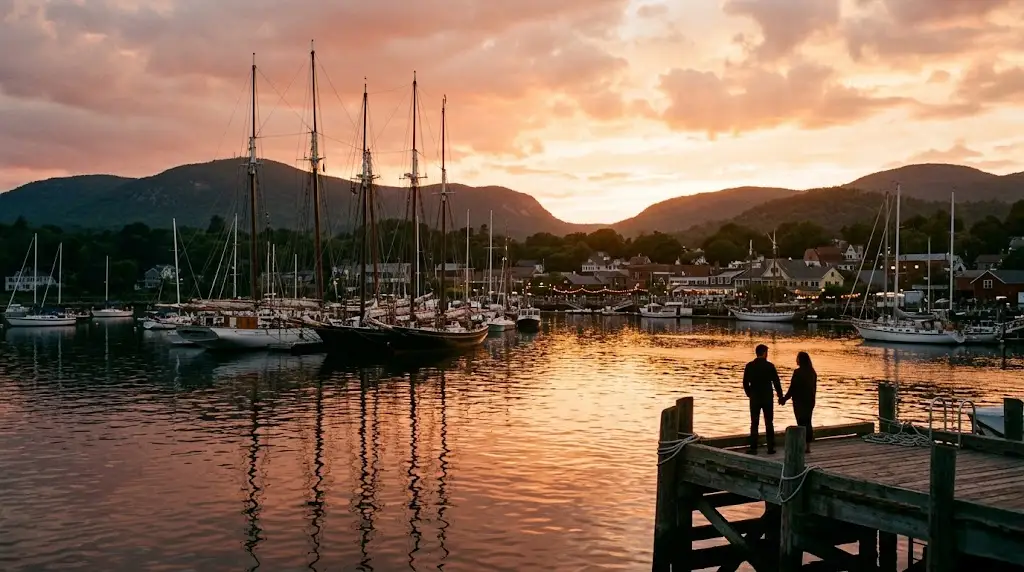
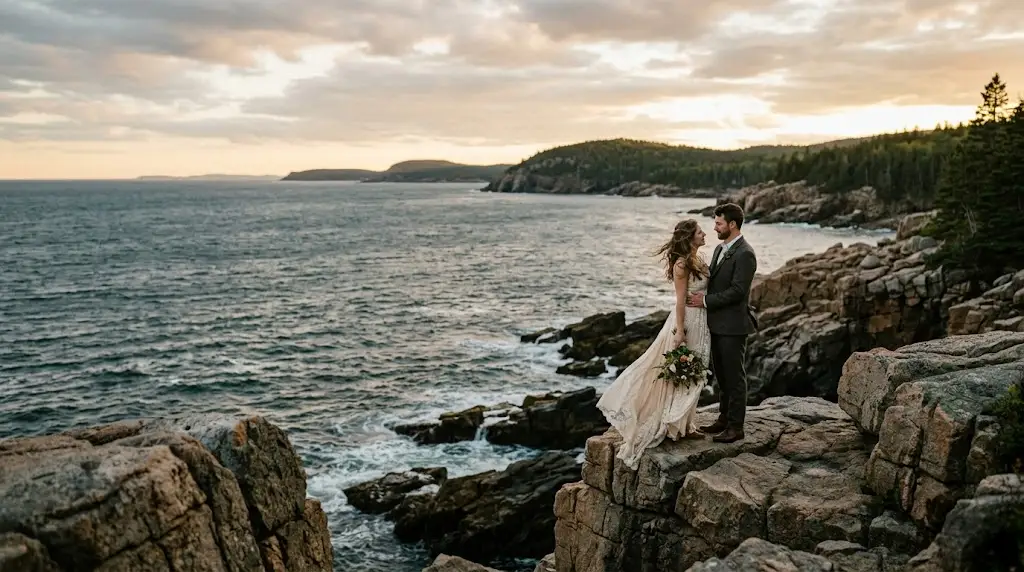
Acadia National Park is one of the most breathtaking places in the country to get married. The granite coastline, the quiet of the carriage roads, the way the light falls over Jordan Pond on a clear morning — there’s nowhere quite like it in New England, and couples who choose it as their backdrop tend to feel that deeply.
But Acadia is also a federally managed national park, and that comes with a set of rules, permits, and logistical realities that are worth understanding well before your wedding day. The couples who have the most seamless experience here are the ones who planned for it. Here’s what you need to know.
Permits: The Most Important Thing to Sort Out First
Any wedding or commitment ceremony taking place within Acadia National Park requires a Special Use Permit from the National Park Service. This applies whether you’re having ten guests or two hundred — and it applies to your vendors, including your videographer.
The permit process involves an application, a fee, and in some cases restrictions on location, group size, and the type of equipment that can be used. Certain areas of the park are more accessible for permitted events than others, and availability is limited — particularly during peak season. The application process can take time, so this is something to initiate early, ideally six months to a year before your date.
Your videographer should be familiar with this process and prepared to be listed on your permit as an approved vendor. If you’re working with someone who isn’t aware that a permit is required, that’s a red flag worth taking seriously.
Choosing Your Location Within the Park
Acadia spans more than 47,000 acres across Mount Desert Island, the Schoodic Peninsula, and Isle au Haut — which means “Acadia” isn’t one setting, it’s dozens. The right location depends on what kind of ceremony you’re envisioning and how accessible you need it to be for your guests.
A few of the most sought-after spots for weddings and elopements:
Jordan Pond. The iconic view of the Bubbles reflected in calm water is one of the most recognizable images in Maine. It’s a popular ceremony location for good reason — but that popularity also means it can be crowded during peak summer months. Early morning ceremonies here tend to be quieter and more intimate.
Thunder Hole and the Ocean Path. For couples who want the drama of the Atlantic — the sound of the sea, the wind, the raw coastline — this stretch offers views that are hard to match anywhere in the Northeast.
Carriage Roads. The 45-mile network of broken-stone carriage roads is one of Acadia’s quieter gems. Ceremonies held here tend to feel removed from the crowds, surrounded by forest and the occasional granite bridge. They’re also highly photogenic in a way that’s distinctly different from the coastal views.
Summit of Cadillac Mountain. For something truly elevated — literally — a sunrise ceremony on Cadillac Mountain, the highest point on the eastern seaboard, is an experience few couples forget. The logistics are more complex, but for the right couple, the effort is absolutely worth it.
Schoodic Peninsula. Quieter and less trafficked than the main island section of the park, Schoodic offers dramatic coastal scenery without the summer crowds. If you’re planning an intimate elopement and flexibility of movement matters to you, this is worth exploring.
What Changes About Videography in a National Park
Filming in Acadia is different from filming at a private venue, and those differences are worth understanding before you book your team.
Drone restrictions. The use of drones is prohibited in Acadia National Park without a specific commercial filming permit — which is separate from the Special Use Permit for your ceremony. This is a firm rule enforced by the park service. If aerial footage is something you want as part of your wedding film, discuss this with your videographer early to understand what’s possible and what isn’t.
No controlled lighting. In most park settings, you won’t be able to use artificial lighting equipment. Your videographer needs to work entirely with available natural light — which in Acadia, during golden hour, is extraordinary. But it also means timing matters enormously. A team experienced in natural light shooting will make this work beautifully; one that relies on supplemental lighting may struggle.
Crowd management isn’t in your control. Popular spots in Acadia will have other visitors during peak season. A skilled videographer knows how to frame, time, and position to minimize distractions — but it requires flexibility and patience that not every team is prepared for. Ask how your videographer handles this before you commit.
No guaranteed exclusivity. Unlike a private venue, you don’t own the space. Other hikers, visitors, and park users will be present. Your ceremony will unfold alongside them. Most couples find this less intrusive than they expected — but it’s worth being mentally prepared for.
Timing and Seasons in Acadia
Acadia is genuinely beautiful in every season, and each one offers something different on film.
Summer (June–August) is peak season — warm, vibrant, and busy. The lupine fields bloom in June, the days are long, and the golden hour light is soft and lasting. Expect more visitors at popular spots and plan accordingly.
Fall (September–October) is arguably the most cinematic season in Acadia. The foliage transforms the park into something that looks almost too beautiful to be real — deep reds and oranges against granite and ocean. Temperatures are comfortable and the crowds thin out after Labor Day. Many videographers consider this the ideal time to shoot in the park.
Winter and early spring offer near solitude and a stark, dramatic quality that appeals to a specific kind of couple. The park is almost entirely to yourself. Conditions can be unpredictable, but the light in winter is extraordinary — low, directional, and incredibly cinematic.
Whatever season you choose, talk to your videographer about what time of day will serve your location best. Cadillac Mountain at sunrise is one thing. Jordan Pond at midday in July is another. Light is everything in outdoor cinematography, and the difference between shooting at the right time and the wrong time is visible in every frame.
Working With Your Videographer on Logistics
Acadia weddings require more logistical coordination than most. Your videographer should be an active participant in that planning, not just a vendor who shows up on the day.
Before your wedding, it’s worth walking through the location together — even virtually, if an in-person scout isn’t possible. Identify where you’ll start, how you’ll move through the ceremony, and where the most important visual moments will happen. This kind of preparation means the team arrives on the day knowing exactly what they’re doing, rather than figuring it out while your ceremony unfolds.
Also think through contingency planning. Maine weather is unpredictable, and Acadia’s coastal and summit locations are particularly exposed. What happens if conditions change on your wedding day? A seasoned team will have thought through this and be ready to adapt — whether that means shifting location, adjusting timing, or making the weather part of the story rather than an obstacle to it.
The Film That Comes Out of It
Couples who get married in Acadia tend to have wedding films that are genuinely unlike anything else. The landscape does a significant amount of the work — but only if the team capturing it has the skill and the eye to let it.
What makes Acadia footage special isn’t just the scenery. It’s the quality of the light, the sound of the environment, the intimacy that comes from being somewhere that feels completely removed from ordinary life. A great wedding film from Acadia preserves all of that — not just what the place looked like, but what it felt like to stand there with the person you love on the day you chose to commit your lives to each other.
That’s a high bar. But it’s exactly what the setting deserves.
At Willow Grove Films, we’ve filmed in Acadia and across coastal Maine, and we know how to work with the park’s landscape, light, and logistics to create something that honors the place and the day. If you’re planning an Acadia wedding or elopement and want to talk through what’s involved, reach out and let’s start the conversation.